
Education & Training
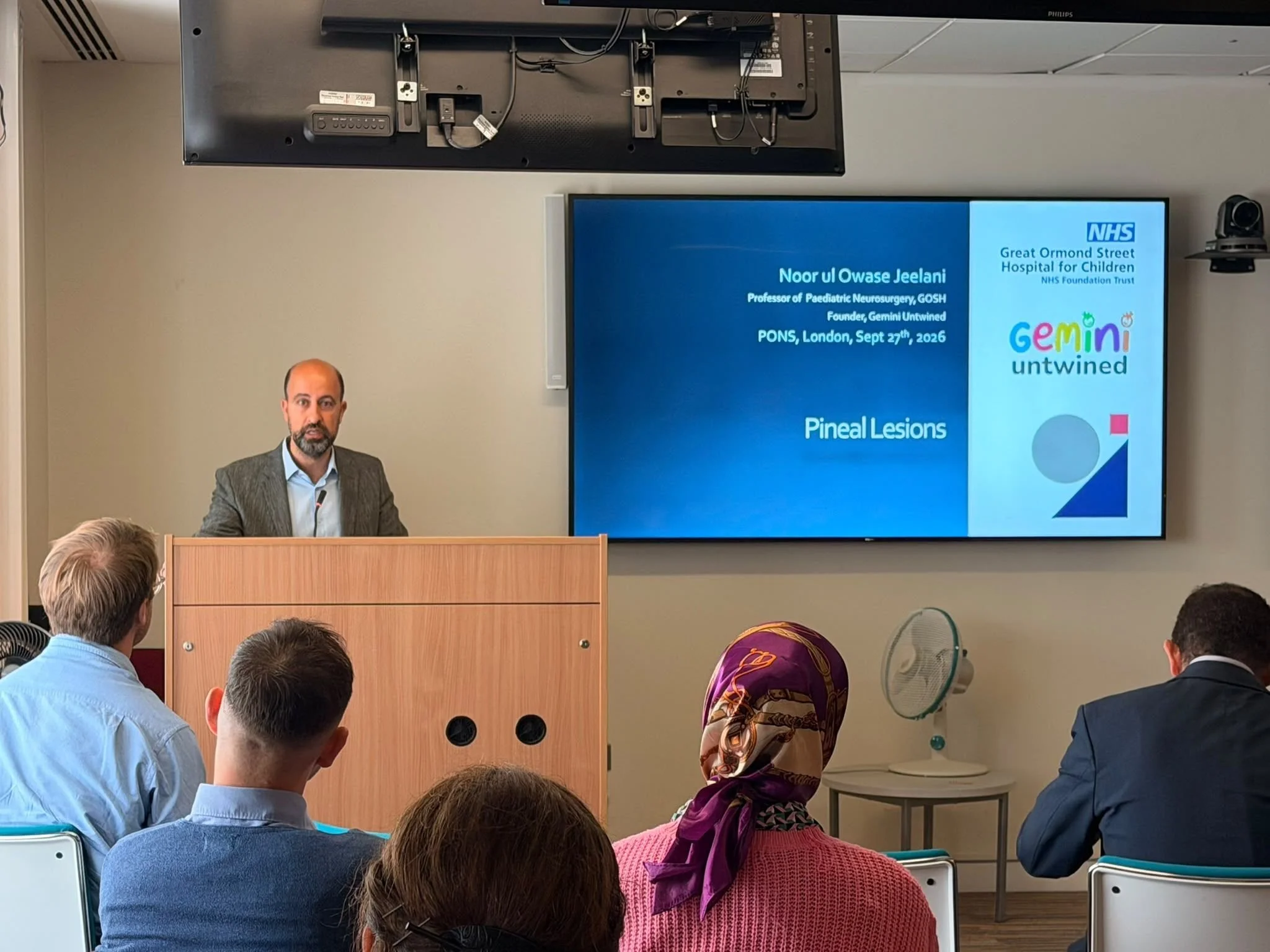
Paediatric neurosurgery is highly specialised. The children who need it may present with rare conditions, complex anatomy, urgent diagnoses and lifelong consequences. No clinician, team or country encounters every challenge often enough to develop all the knowledge it needs in isolation.
Access to expert teaching, shared learning and trusted professional networks can improve decisions and care for many more children. Families need knowledge too. They may have to become experts overnight as they navigate an unfamiliar diagnosis, treatment choices, recovery, school reintegration and long-term uncertainty.
How Gemini makes a difference
Professor Jeelani's teaching and conference work focuses on paediatric neurosurgery, craniopagus twin separation, craniosynostosis, craniofacial reconstruction, spring-assisted cranial expansion, neuro-oncology, global health, virtual and mixed reality, AI-assisted surgical planning, multidisciplinary surgery, and international collaboration. Click here for a selection of Professor Jeelani's recent presentations.
In partnership with Great Ormond Street Hospital, we have recently co-hosted our first three-day training programme for neurosurgeons. Bringing together experienced specialists and trainees to explore the practical decisions involved in complex paediatric surgery. Two sponsored places helped make the programme accessible to participants who might otherwise be unable to attend.
This is the beginning. We plan to develop more opportunities for professionals to learn from one another and to work closely with hospitals, charities and other organisations so that knowledge reaches beyond a single course or specialist centre. We also want families to have clear, trustworthy information when they need it most.
By sharing expertise more widely, we can help strengthen care for children wherever they are treated.
PHD Students Research
Celia Hobbs
'Celia is a research student on the Gemini Untwined PhD Programme, investigating ‘Hemodynamics in craniopagus twins’. She is developing a computational model of shared blood circulation in cranially conjoined twins, with the aim that her findings could be used to improve clinical decision-making and inform personalised surgical planning for twin separation surgery.
She is a graduate from The University of Sheffield, with an MEng in General Engineering and a specialisation in Medical Technologies. This interdisciplinary degree involved studying principles of many engineering disciplines, such as civil, mechanical and electrical, and understanding their specific applications within the medical industry. Her master’s dissertation focused on the use of electrical analogues to model cardiovascular blood flows.'
Sam Neicho
During Craniopagus twin separation, an issue arises of covering the area left open at the top of the cranium with skin. Tissue expansion is a process whereby an excess of skin is created in an area that can be used post surgery to cover this cranial defect. The process works by incrementally filling a silicon balloon to utilise the skin’s natural healing capability, the like of which is seen commonly in pregnancy or weight gain.
Issues currently surrounding the tissue expansion process are not knowing exactly how much to expand by to create enough skin as well as the exact expander placement so that the expanded skin is in the correct area to be used post surgery.
Sam is currently working on predictive modelling of this process, with the end goal being to use a computational model to tell surgeons the best location and orientation for a tissue expander as well as how much to fill by. This work hopes to give surgeons an extra level of confidence when operating and make the tissue expansion process as a whole safer.
How You Can Help
We rely on the help from other people’s generosity. If you’re interested in helping please do follow the link below or fill in the form here. We’d be extremely grateful.